
Storage infrastructure is facing a new reality. Data volumes continue to grow, virtualization environments are expanding, AI-driven workloads are emerging, and cyber resilience has become a board-level concern. At the same time, organizations aim to reduce operational costs and improve sustainability. Meeting all of these requirements with a single storage platform is not easy. Yet this is exactly the challenge many organizations face today.
The new ETERNUS EP300 was developed with these competing demands in mind. Combining enterprise-class all-flash performance, advanced data protection and Eco Power efficiency in a compact design, it provides a practical platform for organizations looking to modernize their storage infrastructure without adding unnecessary complexity.
Performance designed for modern business workloads
ETERNUS EP300 delivers enterprise storage capabilities in a compact 2U form factor. Built on an end-to-end NVMe architecture, the platform supports up to 72 NVMe SSDs and offers high-speed connectivity options including 64G Fibre Channel and 100G NVMe/TCP.
This enables organizations to support demanding workloads while consolidating infrastructure and reducing data center footprint. That combination of performance and density makes the platform particularly well suited for environments where consistent performance matters, including server virtualization, enterprise databases, analytics workloads and business-critical applications.
Rather than deploying separate systems for different requirements, organizations can consolidate multiple workloads onto a single storage platform.
ETERNUS EP300 – eco power by design
Performance remains essential, but it is no longer the only metric that matters. The “EP” in ETERNUS EP300 stands for Eco Power, reflecting the platform’s focus on energy-efficient operation. Dynamic power optimization and intelligent resource utilization help reduce power consumption, cooling requirements and overall CO₂ emissions.
This allows organizations to improve storage performance while supporting sustainability goals and reducing operational costs. In an environment where energy efficiency is becoming an increasingly important infrastructure requirement, storage can play a meaningful role in reducing the overall environmental footprint of the data center.
Built-in cyber resilience
Modern storage systems must do more than store data. They must help protect it. For this reason, ETERNUS EP300 incorporates multiple resilience technologies designed to support business continuity and cyber recovery strategies.
Among these capabilities, immutable snapshot technology plays a particularly important role. Because snapshots cannot be altered or deleted during their defined retention period, they provide protected recovery points that can be used following ransomware incidents or operational errors.
Beyond snapshot protection, the platform also includes advanced snapshot capabilities, replication technologies and support for active-active storage clustering. This enables organizations to build highly resilient environments with continuous access to critical data.
Additional security features such as Hardware Root of Trust and integrated encryption capabilities help establish trust from the lowest layers of the platform upwards.
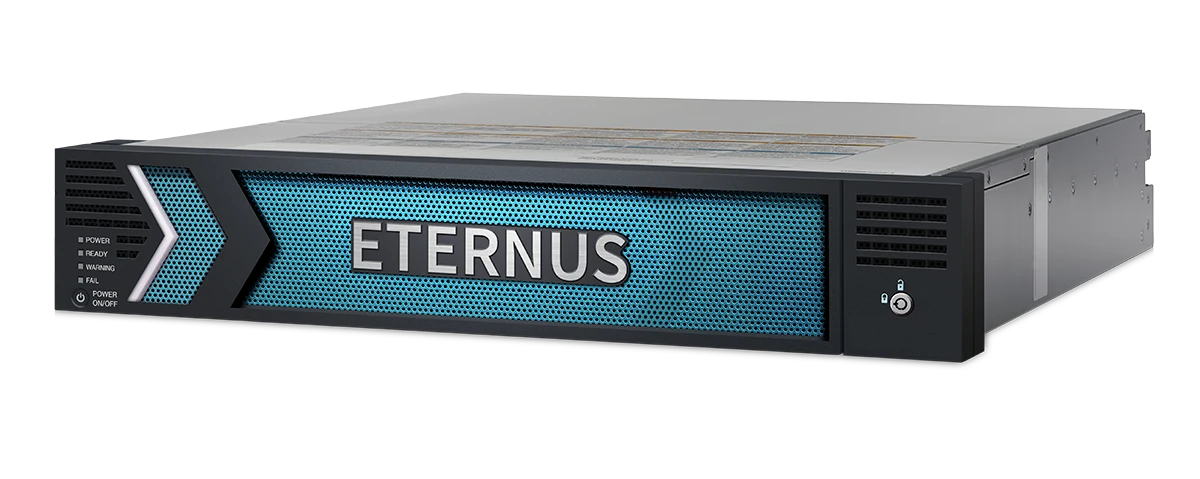
ETERNUS EP300
Built for efficiency, beyond traditional RAID
A good example of the platform’s focus on efficiency is Dynamic Drive Protection (DDP), one of the key technologies within ETERNUS EP300. Unlike traditional RAID approaches that rely on dedicated spare drives and fixed RAID groups, DDP distributes data, parity information and spare capacity across all drives in the system. This improves resource utilization, simplifies expansion and helps accelerate rebuild operations when a drive failure occurs.
Combined with Always-on Compression Acceleration, ETERNUS EP300 improves storage efficiency without creating additional administration overhead. Compression is continuously available, helping organizations increase usable capacity while maintaining performance. The result is a storage platform that helps reduce both infrastructure costs and operational complexity.
Designed for modern data environments: the new ETERNUS EP300
The benefits of this approach become particularly visible in real-world environments, where organizations rarely face a single storage challenge. They need platforms that can support multiple workloads while remaining flexible enough to adapt to future requirements.
We designed ETERNUS EP300 with this reality in mind. Typical deployment scenarios include server virtualization, enterprise databases, mission-critical applications, backup environments, cyber resilience initiatives and data center consolidation projects. Support for storage virtualization further extends flexibility, enabling organizations to integrate existing storage resources and modernize infrastructure at their own pace.
A new generation of sustainable enterprise storage
The most interesting aspect of ETERNUS EP300 is not any single feature. It is the combination of capabilities that are often treated separately.
Organizations no longer want to choose between performance and efficiency, resilience and simplicity, or modernization and sustainability. They need all of these requirements addressed within a single platform. ETERNUS EP300 brings these together, combining enterprise-class all-flash performance, built-in cyber resilience, intelligent efficiency technologies and Eco Power design in one compact system. The result is a storage platform built for modern workloads, business-critical data and the growing demands of sustainable IT.
Learn more about ETERNUS EP300 on our website and discover how it can help your organization modernize storage while reducing complexity, improving resilience and supporting sustainability goals.