

Artificial intelligence is reshaping industries at an unprecedented pace. Yet, as AI ambitions grow, many organizations are discovering an inconvenient truth: the future of computing cannot be built simply by adding more power-hungry hardware.
Power constraints, cooling requirements, rising operational costs, and growing concerns about data sovereignty are emerging as some of the most significant barriers to AI adoption and innovation. For enterprises, cloud providers, and data center operators, the challenge has evolved from achieving peak performance to achieving efficient performance.
The changing nature of AI workloads
The infrastructure requirements for AI have shifted. While large-scale training remains critical, AI inference – the day-to-day operation of models in production – is scaling at a much faster rate.
Unlike training, inference involves many small, latency-sensitive jobs that run continuously. Data center power demand is rising sharply, and inference is driving a growing share of that growth. To thrive, organizations need infrastructure that balances three traditionally conflicting priorities: performance, efficiency, and trust.
Why efficiency has become a strategic priority
For years, processor development focused primarily on delivering more performance. Today, however, energy efficiency has become just as important. Every watt consumed translates into real operational costs, cooling requirements, and environmental impact. In large-scale environments, these factors can significantly influence the total cost of ownership (TCO) by limiting the ability to expand within existing facilities.
As AI workloads continue to expand, efficient processing is becoming a business requirement rather than an engineering preference. Organizations increasingly need platforms that can deliver high throughput while helping reduce power consumption, optimize existing facilities, and extend the usable life of infrastructure investments. The winners of the AI era will not necessarily be those with the largest data centers. They may be the organizations that can accomplish more with the resources they already have.
A new generation of processor design
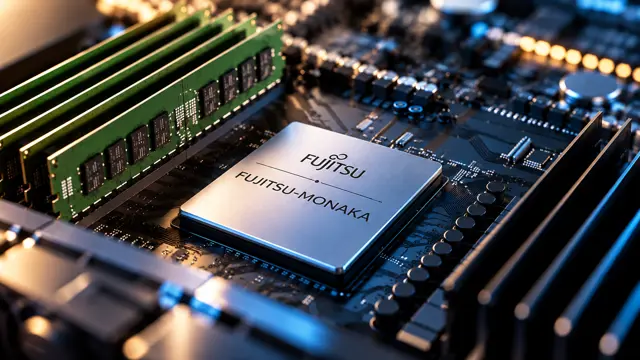
Developed by Fujitsu as a next-generation Arm-based server CPU, FUJITSU-MONAKA is designed to address these specific challenges. Drawing on decades of supercomputing heritage from the K computer and Fugaku, FUJITSU-MONAKA brings enterprise-grade AI inference capabilities to the data center. By combining a 2 nm 3D-stacked architecture with Fujitsu’s proprietary ultra-low-voltage technology, FUJITSU-MONAKA is engineered to deliver:
- AI inference on CPU: Twice the AI inference throughput of other CPUs*, so LLM inference and RAG for small and medium-sized models (below 70B parameters) can run on CPU servers alone.
- Performance per watt: Shorter data paths and lower operating voltage deliver throughput without the power draw that dense AI infrastructure normally implies, helping organizations scale AI within their existing power limits.
- Efficient scaling: Fewer servers and less power for the same inference load, easing pressure on space, cooling, and operating costs.
From processor to platform: the Fujitsu MONAKA Server
For organizations, the processor is only part of the answer. Fsas Technologies, a Fujitsu company, brings FUJITSU-MONAKA to European data centers in the Fujitsu MONAKA Server, a rack-mount server for sovereign AI infrastructure, designed, developed and manufactured in Japan.
- Built for the data centers you already have: Available as 2U and 1U models, the server can operate in an air-cooled environment. The 1U model operates at ambient temperatures of up to 40 °C (under certain conditions) or with inlet water up to 45 °C, cutting server cooling power by up to 80%*.
- AI inference without a GPU procurement cycle: Below 70B parameters, LLM inference and RAG run on the server’s CPUs alone. For larger models, GPUs can be added via PCIe Gen6.
- A familiar ecosystem: Armv9 conformance and support for RHEL and SLES keep adoption straightforward. Orders open in November 2026, with shipments starting from April 2027.
The rise of digital sovereignty
Digital sovereignty has moved from a “nice-to-have” to a design requirement. Governments, public sector organizations, regulated industries, and critical infrastructure providers increasingly want greater visibility, control, and trust across their technology stack. As a result, sovereign AI and sovereign cloud strategies are becoming central considerations for organizations.
The infrastructure platforms of the future will need to deliver not only performance and efficiency, but also transparency, security, and resilience. FUJITSU-MONAKA supports this through Confidential Computing based on Arm CCA, which protects sensitive data while it is in use.
The Fujitsu MONAKA Server adds supply chain transparency: it is designed, developed and manufactured at Fujitsu’s Kasashima Plant in Japan, with component origins and production history made visible and traceable – a robust alternative for organizations looking to reduce dependence on a single supply chain. By combining Made-in-Japan hardware with Confidential Computing, the Fujitsu MONAKA Server provides a foundation for sovereign AI, even in highly sensitive sectors such as defense and government.
Efficiency and sovereignty are converging in European regulation
In Europe, these two requirements are no longer separate conversations. Under the recast Energy Efficiency Directive (EU) 2023/1791 and its delegated regulation (EU) 2024/1364, data center operators above 500 kW of IT load already report energy consumption, efficiency metrics, renewable energy use, water consumption, and waste heat recovery into a central EU database. The European Commission has since presented its Data Centre Energy Efficiency Package, including a proposed common EU rating scheme for data centers. It sits alongside the Cloud and AI Development Act and the Strategic Roadmap for Digitalization and AI in the energy sector.
The direction is clear: efficiency is moving from a cost argument to a compliance argument, and it is arriving in the same legislative package as Europe’s sovereignty agenda. For operators facing fixed grid connections and limited expansion headroom, the decisive question becomes how much useful AI work can be delivered within an existing power envelope. That is precisely the design point of FUJITSU-MONAKA and the Fujitsu MONAKA Server, and the reason Fujitsu and Fsas Technologies treat energy efficiency and digital sovereignty as two sides of the same infrastructure decision.
A different way to think about progress
The AI revolution is often portrayed as a race toward bigger models and more compute power. But long-term success will depend on something different.
Progress must become more intelligent. Organizations must find ways to process more data without consuming proportionally more energy. They must enable innovation without introducing unnecessary complexity. And they must scale AI while maintaining control over their infrastructure, data, and operational costs.
This shift marks a new phase in the evolution of computing. The future belongs to infrastructure that is not only powerful, but purpose-built for sustainability, adaptability, and trust. As AI continues to transform every industry, the most important innovation may not be about doing more. It may be about doing more with less.
Discover how next-generation infrastructure is helping organizations balance AI performance, energy efficiency, and digital sovereignty. Explore the Fujitsu MONAKA Server – available to order from November 2026, with shipments starting April 2027.
* Compared with other CPUs. Performance and cooling figures: Fujitsu estimates; target values for 2027.
This new technology used in FUJITSU-MONAKA is based on results obtained from a project subsidized by the New Energy and Industrial Technology Development Organization (NEDO).
